I’m a Ph.D. candidate in Computer Science and Engineering at the University of Michigan, advised by Stella X. Yu. I received my B.S. in Electrical Engineering from National Taiwan University. I study robot learning and visual perception in real-world settings.
Robot learning. I am interested in scalable learning from diverse data and experience, with human motion as one example of a useful prior. My current work focuses on contact-rich interaction and humanoid whole-body control.
Perception. I study spatial and dynamic understanding from partial observations, semantic localization, and fine-grained understanding of embodied video.
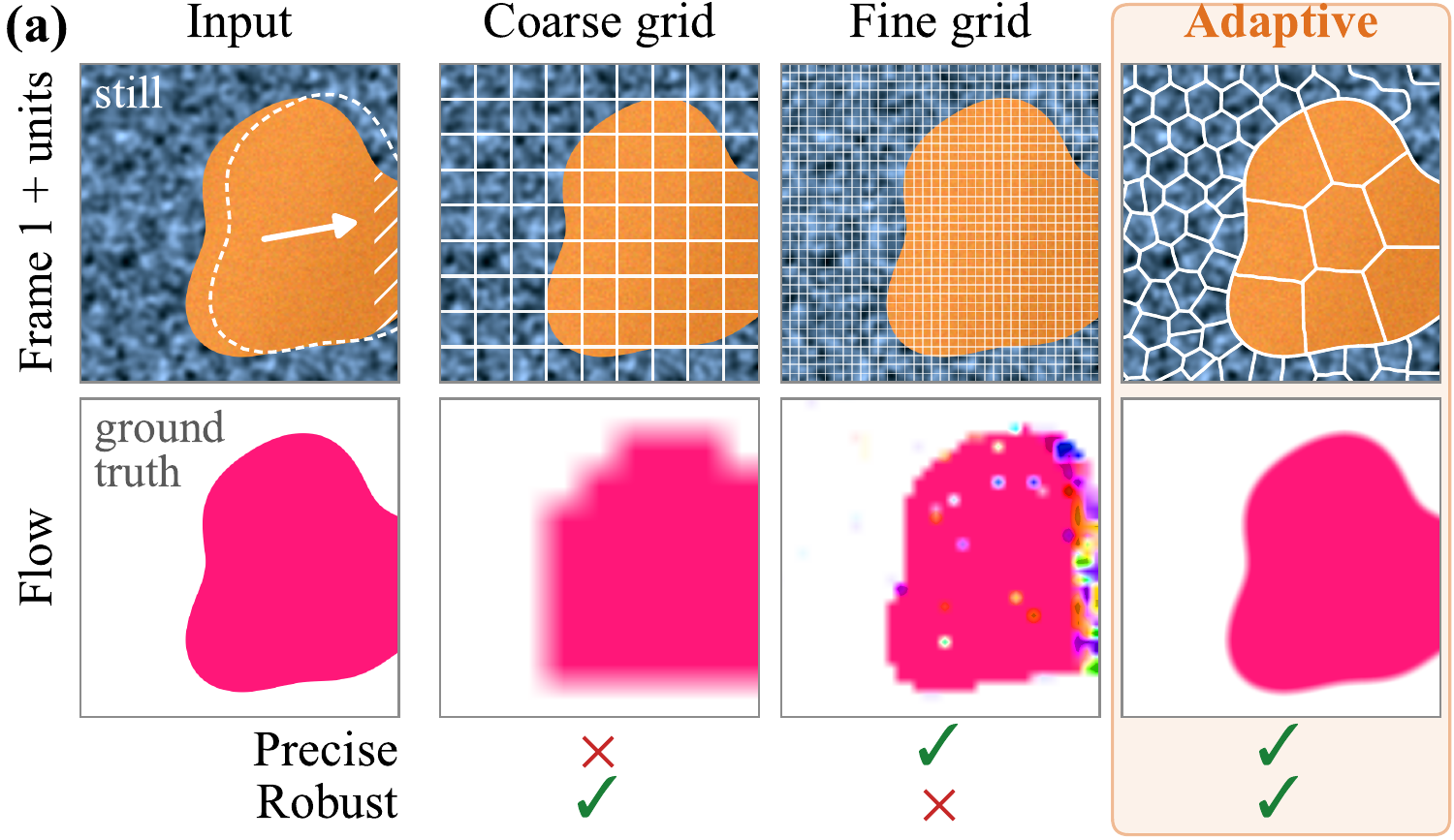
We show that learning what to match is as important as learning how to match. Our adaptive units follow coherent motion and preserve fine boundaries, making optical flow both precise and robust—even where a match is hidden or outside the image.
We turn getting back up into a behavior the robot can adapt and steer. A visual diffusion model lets us guide heading, timing, and route at test time, while a depth-aware controller carries out the recovery on a real Unitree G1.
Where to Hitch? Finding Small, Rare Parts Across Long Spatiotemporal Contexts
C.-L. Hsieh*, Z. Wang*, S. X. Yu, E. Corona, S. Sasidharan, and E. D. Sumer.
NeurIPS Workshop on Long-Context Foundation Models (LCFM), 2026.
Finding a tiny part in a long video can be surprisingly difficult. HitchIt chooses useful views and tracks visual examples to locate parts such as trailer hitches without task-specific training.