TL;DR Optical flow methods estimate motion at fixed grid points. DACE learns which pixels to match together: it groups pixels into adaptive tokens, matches the tokens across frames, and passes their motion back to every pixel. The flow is sharper at motion boundaries and more robust where no match is visible.
Abstract
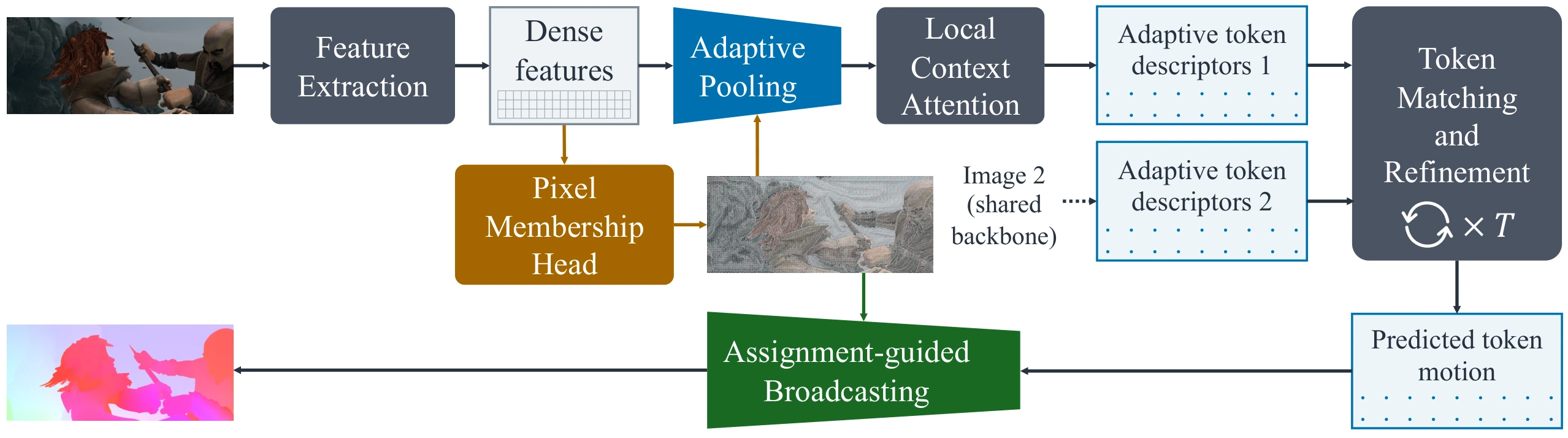
Dense optical flow estimates where every pixel moves between two images. It must be precise and robust. Both properties depend on two choices: which units to match, and what evidence to match them with. Small units localize precisely but carry weak evidence. Large units carry richer evidence but can mix motions across boundaries. Recent work has strengthened the evidence with better features, cost volumes, attention, and generative priors. The unit, however, is still a fixed grid point. We propose DACE: Dense flow from Adaptive CorrespondencE, which learns the units while keeping the evidence dense. A differentiable assignment groups pixels into tokens, builds their descriptors from dense image features, and maps token motion back to pixels as dense flow. Tokens can be large where motion is coherent and small near boundaries and fine detail. Grouping and matching are learned jointly from flow supervision: grouping makes matching easier, and matching shapes grouping. DACE achieves the lowest zero-shot Sintel Final and KITTI endpoint errors among published methods, with fewer MACs than most. Controlled comparisons with fixed grids show that the gain comes from the adaptive units, which make DACE both more precise near motion boundaries and more robust where no match is visible, such as at occluded or out-of-frame pixels.
Improve the unit, not just the evidence
Flow methods match units between two frames using image evidence. For years, progress has come from better evidence while the unit stayed a fixed grid point. DACE changes the unit.
Better evidence
Match the same fixed grid points with stronger evidence.
- 2018PWC-Net cost volumes
- 2020RAFT all-pairs correlation
- 2022GMFlow, FlowFormer transformers
- 2023DDVM diffusion priors
- 2025WAFT feature warping
Better units
Learn which pixels to match together, and keep the evidence dense.
- Small tokens at motion boundaries: precise
- Large tokens where motion is coherent: robust
- Grouping is learned from motion, jointly with matching
The task: every pixel in frame 1 needs a motion vector. A method 1groups the pixels into units, 2finds each unit in frame 2, and 3gives every pixel the motion of its unit.

Recovering motion where no match is visible, preserving fine structure
Zero-shot predictions on Sintel and KITTI, after training on synthetic data. WAFT matches a 2× finer fixed grid; DACE matches adaptive tokens.
Drag to compare WAFT and DACE. Hover to magnify; the panels above mark the same point.
How to read these images
Hue gives the direction of motion and color intensity its speed; white means no motion. The flow maps of one example share a color scale. In the no-visible-match map, blue marks pixels that are occluded or leave the frame, gray the other labeled pixels, and black pixels without labels. Black in the ground truth also marks missing labels; KITTI's sparse labels are enlarged for display.
Group pixels into tokens, match the tokens, broadcast motion back
Every step is differentiable, so grouping and matching are learned together, end to end.
Soft memberships decide what each token covers
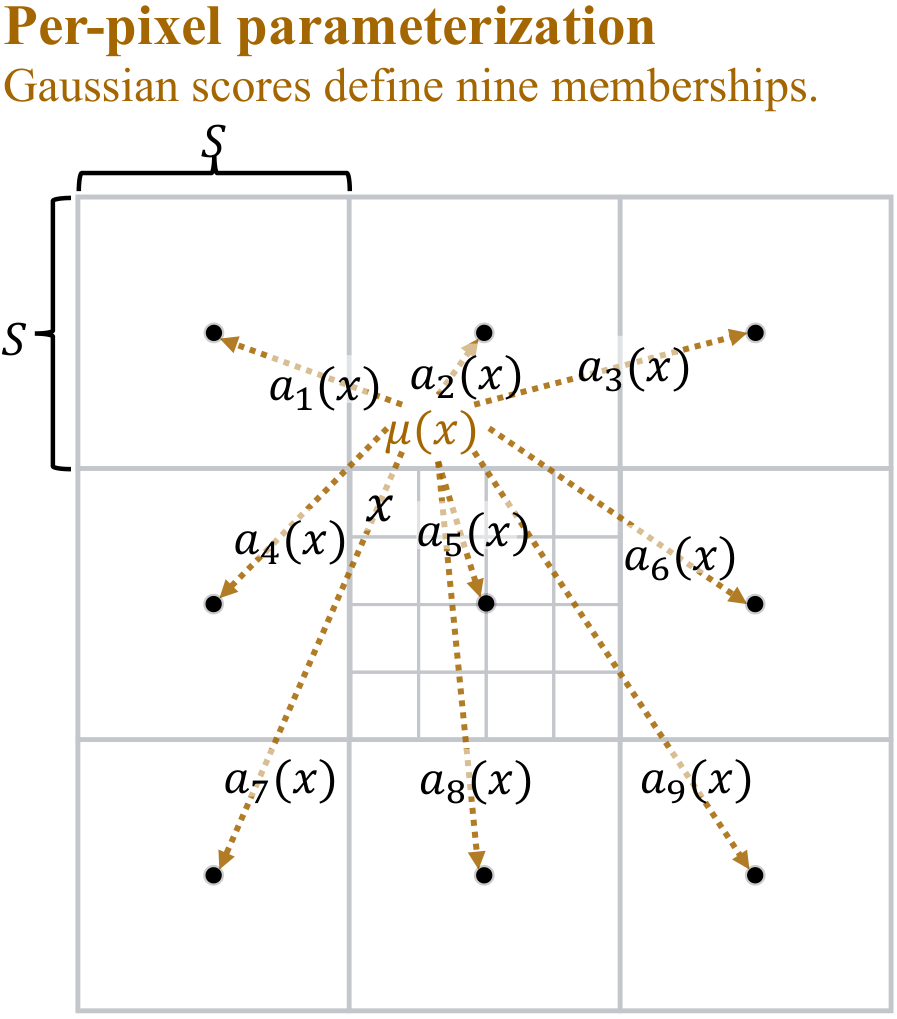
Tokens sit on a coarse lattice, but the image decides which pixels each token covers. Each pixel \(x\) belongs softly to the nine tokens around it, with weights from a Gaussian it predicts (mean \(\mu(x)\), inverse covariance \(G(x)\)) over the anchor offsets \(\delta_i\):
Drag the orange point \(\mu(x)\) to move the Gaussian.
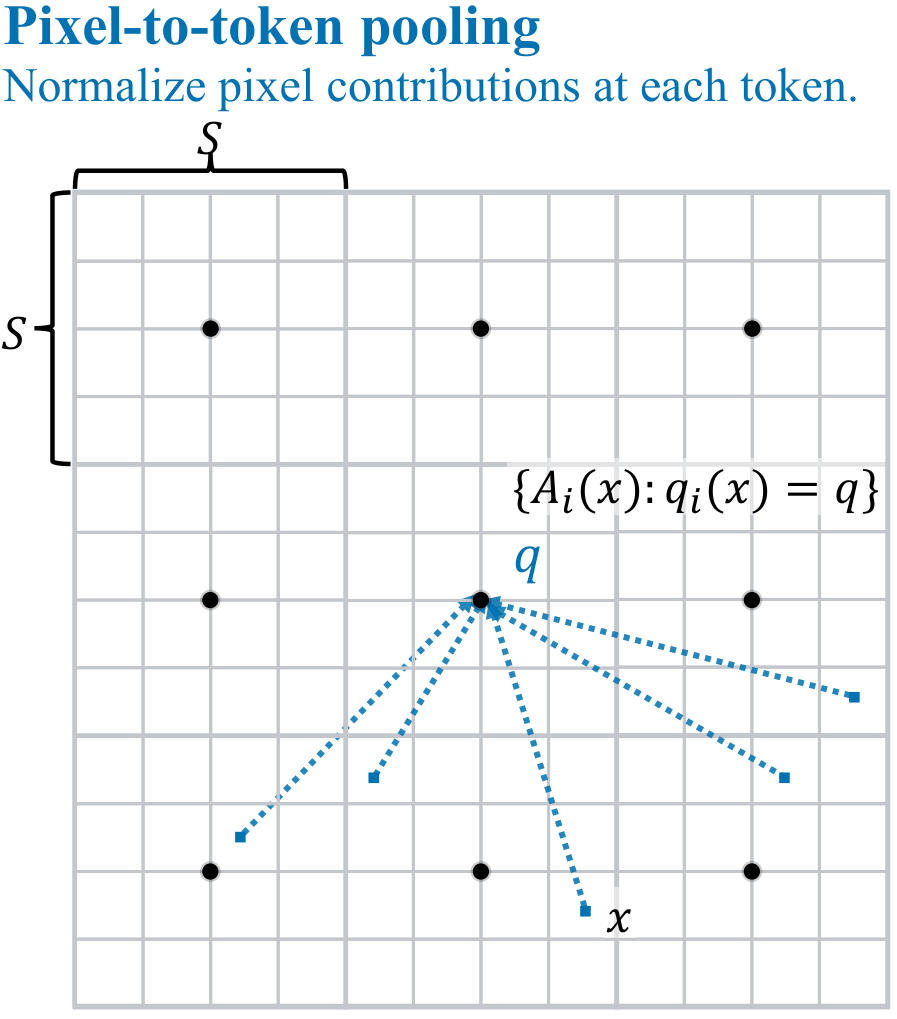
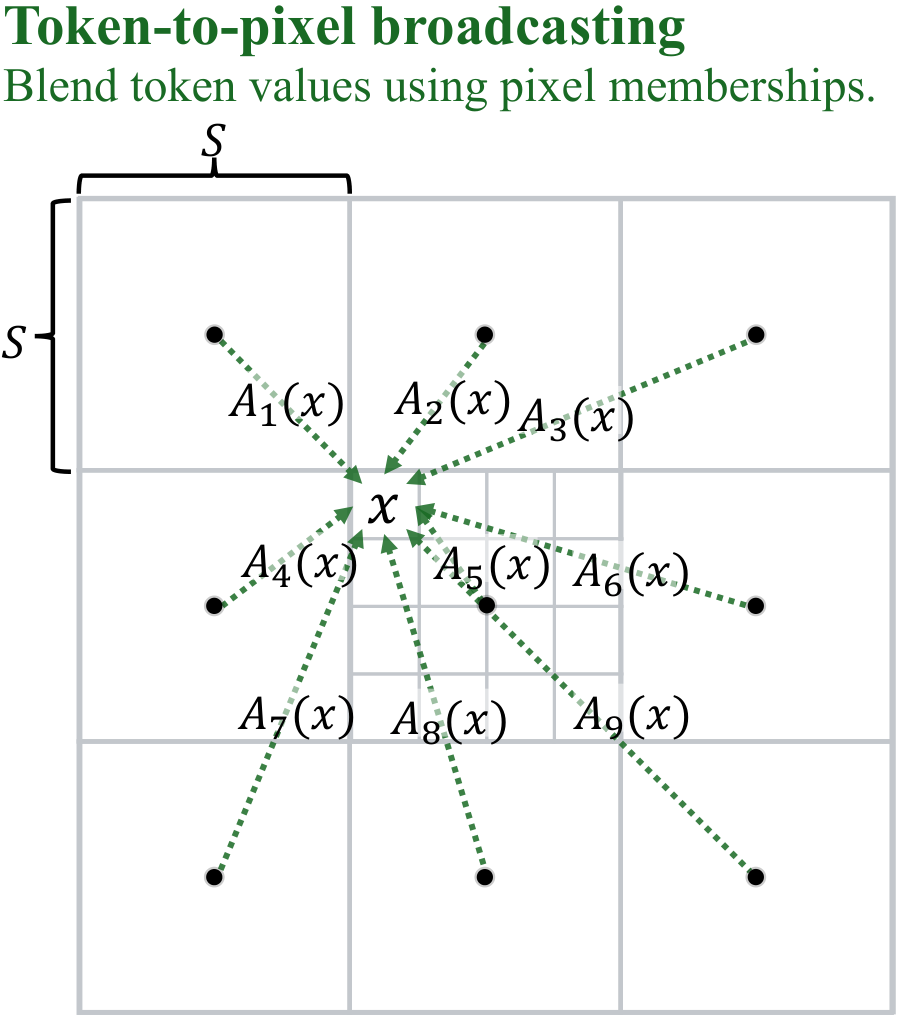
Because a token passes its motion to all of its pixels, a pixel with no visible match inherits motion from the visible part of its token.
Grouping is learned from motion alone
No segmentation labels or appearance losses. Three losses on ground-truth flow train the whole model:
Each token predicts its motion, supervised by the ground-truth flow pooled over its pixels.
Each pixel learns to favor the token whose motion best explains its own, which sharpens grouping at motion boundaries.
Ground-truth flow pooled into tokens and broadcast back should reproduce the original flow, so each token keeps to one motion.
Lowest zero-shot endpoint error on Sintel Final and KITTI
Every model is trained on the synthetic FlyingChairs and FlyingThings3D datasets, then tested on Sintel and KITTI, which it has never seen.
Show the numbers
The gain comes from the adaptive units
To isolate the units, we compare DACE with fixed-grid models that share everything else.
Show the numbers
DACE learns the units of correspondence. Matching adaptive tokens instead of fixed grid points makes optical flow more precise at motion boundaries and more robust where no match is visible. Learning what to match complements learning how to match it.
Citation
@inproceedings{hsieh2026dace,
  title     = {Dense Flow from Adaptive Correspondence},
  author    = {Hsieh, Cheng-Lin and Yu, Stella X.},
  booktitle = {Advances in Neural Information Processing Systems (NeurIPS)},
  year      = {2026}
}
Acknowledgements
This project was supported in part by NSF grant 2313151, with additional computing resources provided through NAIRR Pilot CIS240421 and CIS240431. The authors thank SpixelFCN and WAFT for sharing their code.